If you have ever organized a medical, scientific, or academic conference, you already know the specific chaos that abstract season brings.
One day, you’re launching the call for papers. The next, you are drowning in spreadsheet versions named Abstracts_v4_FINAL_updated(2).xlsx. Authors are emailing to ask if their figures uploaded correctly, reviewers are missing deadline reminders hidden in their spam folders, and your scientific committee is trying to manually map accepted submissions into a coherent presentation schedule.
When abstract submission, peer review, and final presentation (oral sessions or ePosters) live in separate systems, things fall through the cracks. Moving to a single, end-to-end platform isn’t just a convenience—it’s the difference between a smooth event and an administrative nightmare.
The Risk of a Fragmented Abstract Workflow
Using one tool for submissions, another for reviews, and standard email or USB drives for the actual presentations creates unnecessary friction:
- Data Discrepancies: Handing off accepted abstracts from a review tool to an event schedule or ePoster gallery manually almost guarantees typos, misattributed author names, or misplaced files.
- Reviewer Burnout: Peer reviewers are volunteers with busy schedules. If accessing assignments requires navigating clunky email chains or unfamiliar software, reviews get delayed.
- Strained Author Experience: Researchers put months into their work. When they face broken upload forms or zero visibility into their submission status, it reflects poorly on the conference brand.
- Onsite Panics: Nothing stalls a live session quite like a presenter realizing their final slide deck or ePoster file didn't make it to the hall AV system because it was collected via a separate form.
Why a Single-Platform Process Changes Everything
When your abstract lifecycle runs on one unified system—from the initial submission form all the way to the presentation hall—the entire dynamic shifts.
1. One Source of Truth for Every Paper
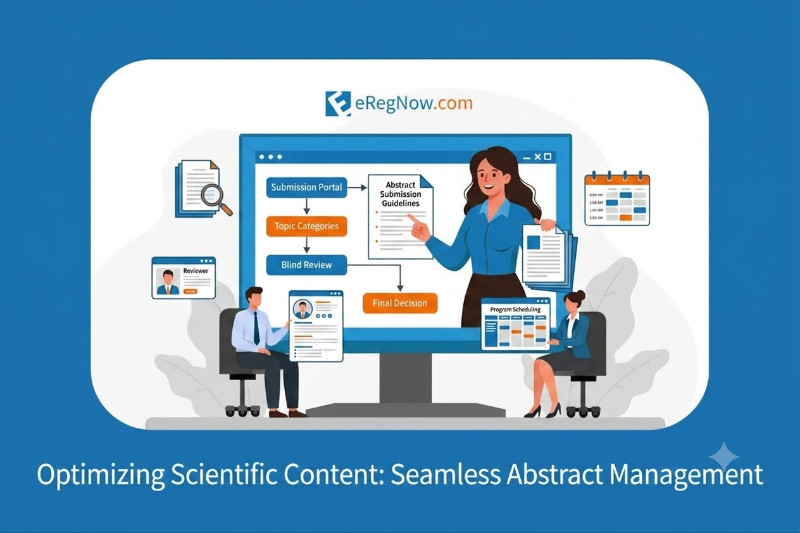
When an author submits an abstract, that record remains intact throughout its lifecycle. Once accepted, the same submission converts directly into a scheduled oral presentation or an ePoster display without any manual data re-entry.
2. Automated, Hassle-Free Review Cycles
A unified dashboard assigns submissions to reviewers based on topic or track automatically. Reviewers log in, score papers, and leave feedback in one place, while committee chairs get real-time tracking on review progress.
3. Instant Speaker & Schedule Synchronization
Once the scientific committee finalizes accepted papers, you can build your program schedule directly inside the platform. If a presentation time changes, the program schedule on your event website and app updates instantly—and automated notification emails go out to the affected authors.
4. Seamless Onsite & Digital Presentation
For ePosters, authors upload their final digital posters directly into their existing portal. Attendees can browse these ePoster displays on onsite touchscreens or through the event web app, complete with real-time analytics on viewer engagement. For oral sessions, speakers know their exact hall, time, and topic without back-and-forth emails.
The Bottom Line
Your scientific committee should be spending its time curating great content, not copying data between spreadsheets. By bringing submissions, peer reviews, program scheduling, and ePoster displays onto a single platform, you eliminate administrative overhead, keep authors happy, and deliver a seamless experience for every attendee in the room.